E-Survey of Road Users’ Attitudes (ESRA) - India Country Fact Sheet

ESRA (E-Survey of Road Users’ Attitudes) is a joint initiative of road safety institutes, research centres, government departments, and private sponsors, from all over the world. The aim is to collect and analyse comparable data on road safety performance, in particular road safety culture and behaviours for policy measures.
The ESRA data collected is used as a basis for a large set of road safety indicators. It provides scientific evidence for policy measures at national and international levels. Vias institute in Brussels (Belgium) initiated and coordinates ESRA, in cooperation with eleven core group partners. At the heart of ESRA is a jointly developed questionnaire survey, which is translated into national language versions. The themes covered include: self-declared behaviour, attitudes and opinions on unsafe traffic behaviour, enforcement experiences and support for policy measures. The survey addresses different road safety topics (e.g. driving under the influence of alcohol, drugs and medicines, speeding, distraction) and targets car occupants, motorcycle and moped drivers, cyclists and pedestrians.
This country fact sheet contains key results of the second edition of the ESRA survey, which was conducted simultaneously in 32 countries in 2018. In total this online panel survey collected data from more than 35 000 road users (1035 in India).
E-Survey of Road Users’ Attitudes (ESRA) - Australia Country Fact Sheet
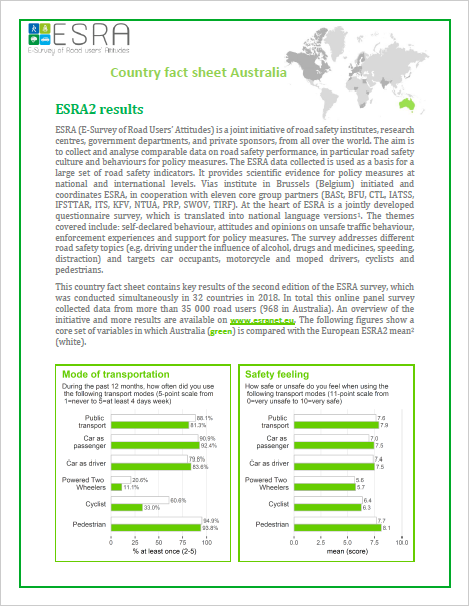
ESRA (E-Survey of Road Users’ Attitudes) is a joint initiative of road safety institutes, research centres, government departments, and private sponsors, from all over the world. The aim is to collect and analyse comparable data on road safety performance, in particular road safety culture and behaviours for policy measures.
The ESRA data collected is used as a basis for a large set of road safety indicators. It provides scientific evidence for policy measures at national and international levels. Vias institute in Brussels (Belgium) initiated and coordinates ESRA, in cooperation with eleven core group partners. At the heart of ESRA is a jointly developed questionnaire survey, which is translated into national language versions. The themes covered include: self-declared behaviour, attitudes and opinions on unsafe traffic behaviour, enforcement experiences and support for policy measures. The survey addresses different road safety topics (e.g. driving under the influence of alcohol, drugs and medicines, speeding, distraction) and targets car occupants, motorcycle and moped drivers, cyclists and pedestrians.
This country fact sheet contains key results of the second edition of the ESRA survey, which was conducted simultaneously in 32 countries in 2018. In total this online panel survey collected data from more than 35 000 road users (968 in Australia).
Road Safety Calculator Strategic Design Support Tool Outreach Webinar
The World Bank Global Road Safety Facility, Iowa State University and Monash University would like your thoughts on a new tool that is being designed to support road safety strategy selection in low- and middle-income countries. Please participate in one of our webinars to help us understand your road safety analysis needs.
There are webinars scheduled across 12 global time zones for viewing convenience. Please see the linked flyer for full details on registration.
Contact Person
Guide for Road Safety Opportunities and Challenges: Low and Middle-Income Country Profiles

The Guide for Road Safety Opportunities and Challenges: Low and Middle-Income Country Profiles, is the first data report to cover all 125 LMICs with comprehensive road safety country profiles. The profiles present information on each pillar of road safety—management, roads, speed, vehicles, road users, and post-crash care—, to help countries and development practitioners identify challenges and opportunities, and monitor progress. The guide gives a precise assessment on the magnitude and complexity of road safety challenges faced by LMICs and helps policy makers understand the road safety framework in context of their own country systems and performance.
This report responds to the critical need for collecting and documenting accurate road safety performance data. It assembles information from multiple important and high-quality sources to take stock of any given country’s past achievements on road safety, establishing a baseline for the next decade of action across many areas of policy and performance.
The Guide for Determining Readiness for Speed Cameras and Other Automated Enforcement is particularly designed to address the questions of many countries who are considering the introduction of a speed camera program, or similar automated system. These technologies are, on the whole, effective, but require extensive ground work to ensure their benefits - and many countries have not yet engaged in this ground work but are considering these systems.
Questions a country must answer prior to implementing automated enforcement systems can include: are most vehicles registered? Do they have a readable identification/number/registration plate for the camera? Do records allow for the owner/driver to be contacted through their home address or mobile number?
For countries not yet prepared for automated enforcement systems, this guide sets out a path of development and lists the necessary areas of focus prior to the introduction of speed cameras. Like any system, it is important not to expect perfection from speed cameras or similar systems, only a reasonable level of performance.

Practical Road Safety Engineering Workshop, July to August 2020
Contact Person
UN General Assembly Resolution on Road Safety - August 2020
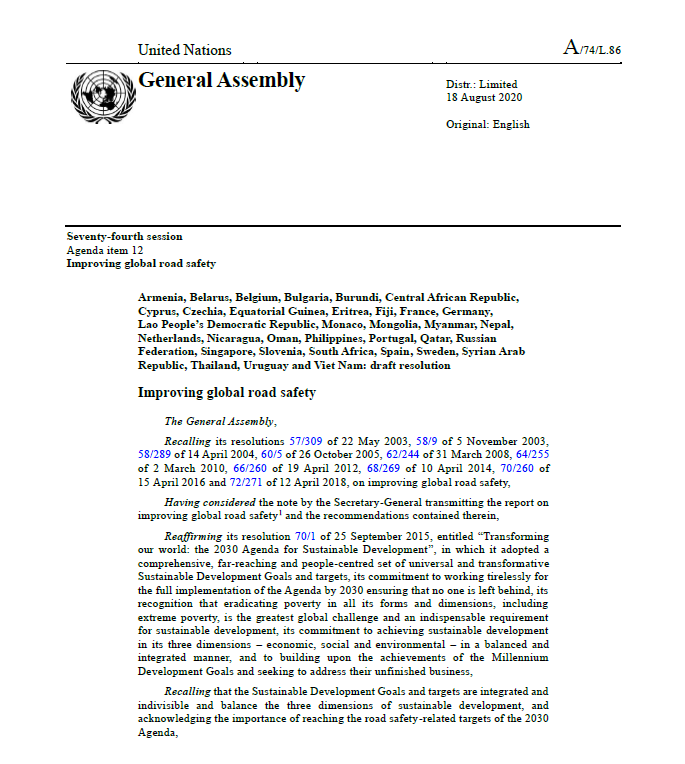
The UN General Assembly has adopted a new resolution on global road safety, recalling that the Sustainable Development Goals are integrated and indivisible, and acknowledging the importance of reaching the road safety-related targets of the 2030 Agenda.
Video Message by Bambang Susantono - First Workshop on the Implementation of the Asia Pacific Road Safety Observatory
Every day, more than 3,500 people die in road crashes worldwide; 100,000 or more are injured or disabled. Road trauma is a serious and ongoing public health crisis. Crash costs are typically 2-5% of national GDP each year, impacting every country on earth. In particular, this crisis affects developing countries, where 9 out of 10 road deaths occur.
The United Nations has included road safety as a Sustainable Development Goal (3.6) setting the challenge of halving the number of global deaths and injuries from road traffic crashes by 2020. In addition, the UN Global Road Safety Performance Targets include objective and achievable targets for all new roads to be built to a 3-star or better standard for all road users (Target 3), and more than 75% of travel is on the equivalent of 3-star or better roads for all road users by 2030 (Target 4). iRAP believes that road death and injury is preventable and that the solutions exist. Improving the world’s roads to a 3-star or better standard for all road users is a key way to meet the UN targets in combination with action across all the established road safety pillars. Achieving >75% of travel on 3-star or better roads by 2030 will save an estimated 467,000 lives every year.
iRAP’s systematic approach can help save thousands of lives. It involves simple, affordable improvements to road infrastructure and speed management that can dramatically reduce both the risk of crashes occurring and their severity.
iRAP programmes can be easily integrated into existing or new road safety initiatives in a country:
- Risk Maps provide a global standard to measure and benchmark historical crash performance and target action;
- Star Ratings provide an objective, evidence-based global measure of the safety of infrastructure for pedestrians, cyclists, motorcyclists and vehicle occupants;
- Safer Road Investment Plans can help shape an upgrade programme and Safer Roads Fund that will maximise lives saved per unit of investment; and
- Policy and performance tracking tools provide agencies with the ability to measure and manage success.
This brochure is designed to help countries develop their own locally owned and led national or state programmes and develop and deliver projects that save lives.
iRAP is a member of the United Nations Road Safety Collaboration and Global Alliance of NGOs for Road Safety and works closely with the World Health Organisation, FIA Foundation, World Bank, International Transport Forum, PIARC, OECD and other road safety stakeholders to support and coordinate global action across all pillars of action on road safety.

iRAP - Vaccines for Roads: Fifth Edition

Unlocking the potential of the world’s largest road infrastructure safety database to explore the human and financial impact of road injury, how safe the world’s roads are and provide the Business Case for Safer Roads.