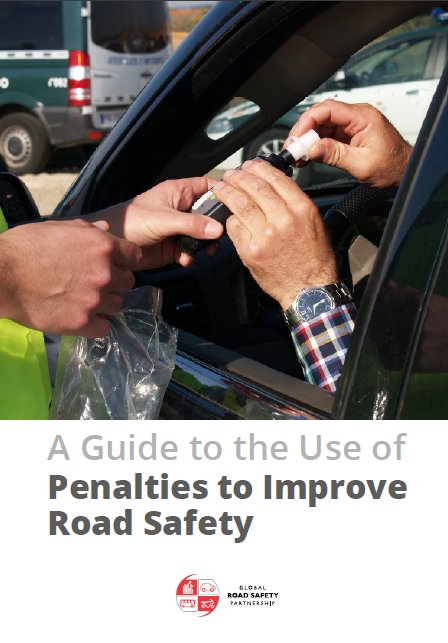
This Guide provides information about different types of penalties that have been applied to traffic offences.
Penalties for traffic offences are a critical component of behaviour change techniques that have been used
extensively with the aim of encouraging road users to comply with traffic laws and to use the road system
safely. Having evidence-based legislation in place is important, but alone, it will not sufficiently deter illegal behaviours. Compliance with traffic laws can be achieved from the combined effects of legislation, increased
public awareness, enforcement, and penalties. This Guide focuses on the penalty component only.
This Guide describes ways in which a robust penalty system may be implemented and draws on international evidence to inform recommendations. It is important to note that there is no pre-defined way to easily determine how severe a penalty should be to deter people from committing a traffic offence. Different penalties are likely to impact people in different ways.
For example, a monetary fine might be meaningful and influential for someone with limited financial resources, yet may have no influence on the offending behaviour of someone who can easily afford to pay the monetary fine. Conversely, a person with greater financial means
may be influenced more effectively by receiving a demerit point penalty than a monetary fine.
Cost of Fatalities and Serious Injuries Cost as % of country GDP
Road accidents inflicts high economic costs. This ratio considers economic costs of road accidents with GDP (SEC-SEG-001).
Deaths by Road User Category - motorised 2/3W
Cost of Fatalities and Serious Injuries
Road accidents inflicts high economic costs. This indicator reports economic costs of road accident injuries in USD.
A New Toolkit for Post-Crash Response
In May, the European Bank for Reconstruction and Development and the Eastern Alliance for Safe and Sustainable Transport (EASST), with support from UK Aid through the World Bank Global Road Safety Facility, launched a new training toolkit with resources to enhance the effectiveness of post-crash emergency medical and rescue operations.
Contact Person
Asian Transport Outlook Database
BASELINE Project: Methodological guidelines – KPI Speeding

The Communication of the European Commission “Europe on the Move – Sustainable Mobility for Europe: safe, connected and clean” of the 13th of May 2018 confirmed the EU's long-term goal of moving close to zero fatalities in road transport by 2050 and added that the same should be achieved for serious injuries. It also proposed new interim targets of reducing the number of road deaths by 50% between 2020 and 2030 as well as reducing the number of serious injuries by 50% in the same period. To measure progress, the most basic – and important – indicators are of course the result indicators on deaths and serious injuries.
In order to gain a much clearer understanding of the different issues that influence overall safety performance, the Commission has elaborated, in cooperation with Member State experts, a first set of key performance indicators (KPIs). The KPIs relate to main road safety challenges to be tackled, namely: (1) infrastructure safety, (2) vehicle safety, (3) safe road use including speeding, alcohol, distraction and the use of protective equipment, and (4) emergency response. The aim of the KPIs is connected to EC target outcomes.
The aim of the BASELINE project, funded partially by the European Commission, is to assist participating Member States’ authorities in the collection and harmonized reporting of these KPIs and to contribute to building the capacity of Member States which have not yet collected and calculated the relevant data for the KPIs. The outcomes of this project will be used to set future European targets and goals based on the KPIs.
The purpose of this document is to further describe the minimum methodological requirements needed to qualify for the BASELINE KPIs for speeding, defined as: percentage of vehicles travelling within the speed limit.
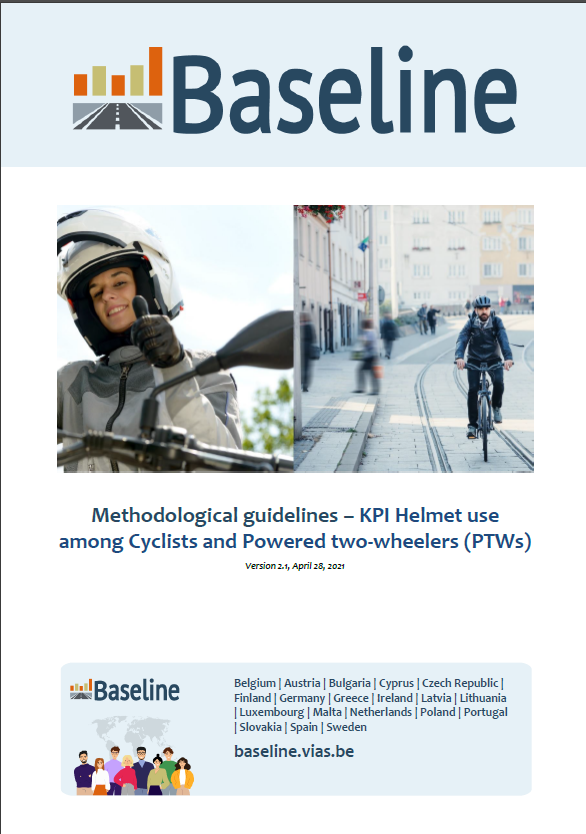
BASELINE Project: Methodological guidelines – KPI Helmet use among Cyclists and Powered two-wheelers (PTWs)
The Communication of the European Commission “Europe on the Move – Sustainable Mobility for Europe: safe, connected and clean” of the 13th of May 2018 confirmed the EU's long-term goal of moving close to zero fatalities in road transport by 2050 and added that the same should be achieved for serious injuries. It also proposed new interim targets of reducing the number of road deaths by 50% between 2020 and 2030 as well as reducing the number of serious injuries by 50% in the same period. To measure progress, the most basic – and important – indicators are of course the result indicators on deaths and serious injuries.
In order to gain a much clearer understanding of the different issues that influence overall safety performance, the Commission has elaborated, in cooperation with Member State experts, a first set of key performance indicators (KPIs). The KPIs relate to main road safety challenges to be tackled, namely: (1) infrastructure safety, (2) vehicle safety, (3) safe road use including speed, alcohol, distraction and the use of protective equipment, and (4) emergency response. The aim of the KPIs is connected to EC target outcomes.
The aim of the BASELINE project, funded partially by the European Commission, is to assist participating Member States’ authorities in the collection and harmonized reporting of these KPIs and to contribute to building the capacity of Member States which have not yet collected and calculated the relevant data for the KPIs. The outcomes of this project will be used to set future European targets and goals based on the KPIs.
The purpose of this document is to further describe the minimal methodological requirements to qualify for the BASELINE KPIs for safety belts and child restraint systems, defined as: percentage of riders of powered two-wheelers and bicycles wearing a protective helmet